|
 |
 |
|
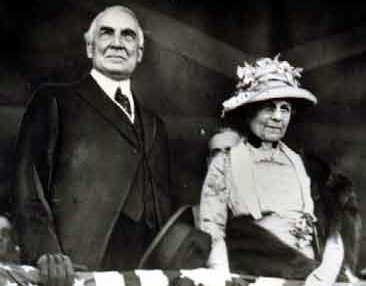
Following his death, Harding's body was returned to Washington, where it was placed in the East Room of the White House pending a state funeral at the United States Capitol. White House employees at the time were quoted as saying that the night before the funeral, they heard Mrs. Harding speak for more than an hour to her dead husband. The most commonly reported (though never verified) remark attributed to Mrs. Harding at this time was: "They can't hurt you now, Warren." Harding was entombed in the receiving vault of the Marion Cemetery, Marion, Ohio, in August 1923. Following Mrs. Harding's death on November 21, 1924, she too was temporarily buried next to her husband. Both bodies were moved in December 1927 to the newly completed Harding Memorial in Marion, which was dedicated by President Herbert Hoover in 1931. The lapse between the final interment and the dedication was due in part to the aftermath of the Teapot Dome scandal. In 1930, a former private investigator named Gaston Means wrote an exploitative book, The Strange Death of President Harding, in which he suggested many people had motives to murder the president, including Mrs. Harding. Means claimed it was possible that Mrs. Harding poisoned the president, a rumor that has clouded the facts of Harding's death and heart condition. In 1933, an exposé in Liberty magazine denounced Means as a fraud who used a ghost writer for the book. The theories advanced by Means—who had previously been imprisoned for his suspect activities while an FBI agent—have never been proven; they remain as speculative as they were sensational. Scandals Those who hold to the theory of mixed race do so without proof, often relying on the research of William Estabrook Chancellor for details of Harding's supposed African-American lineage. There is no scientific or legal basis for these arguments. Chancellor's work never provided clear indications of his sources, or his proof. In fact, so few copies of his book exist—one of five known copies is owned by a private book collector in Marion, Ohio—that its availability to modern scholars is limited at best. Furthermore, there has never been a test of Harding's DNA. The claim is also impossible to verify through public records in Ohio; Harding was born in 1865, and the state of Ohio did not require registration or recording of births until 1867. Furthermore, Chancellor's theories find no basis in Federal census records, nor in probate court records. Harding's 1923 California-issued death certificate also indicates nothing to suggest Chancellor's theories were accepted as fact. With the release in the 1960s of Francis Russell's The Shadow of Blooming Grove, the specter of Harding's mixed blood was again raised and, lacking factual sources, quickly put down as innuendo. There has been speculation that Harding was involved in the Ku Klux Klan. Historians Wyn Craig Wade and Glenn Feldman are among those who promote the theory. Both assert that Harding joined the Klan following his election, taking his Klan oath in the Green Room of the White House. Wade's evidence is dismissed by several Harding biographers as based on third-party hearsay. Wade uses as evidence letters written by members of the Calvin Coolidge administration. However no primary source material—that is to say material either written by Harding admitting to support of the Klan, or any documentation by members of the Harding administration to support Craig and Wade's assertions—is known to exist. Recent Harding biographers Robert Ferrell, Carl Anthony and John Dean not only dispute this claim, but also point to the allegations as an example of the rumors that surrounded the President after his death. Melinda Gilpin, site administrator for the Harding Home and Museum in Marion, argues there is no primary evidence of Harding's Klan membership and points out that Harding was the first US president to speak out against the practice of lynching blacks. Gilpin also points to the Klan's "one drop rule" (that no one who possessed one drop of Negro blood could join the Klan) was in direct conflict with the rumors that swirled around Harding and his mixed race. Upon winning the election, Harding appointed many of his old allies to prominent political positions. Known as the "Ohio Gang" (a misleading term used by Charles Mee, Jr., for his book of the same name), some of the appointees used their new powers to rob the government. Corruption was rampant throughout Harding's administration, though it is uncertain how much Harding himself knew about his friends' illicit activities. The most infamous scandal of the time was the Teapot Dome affair, which shook the nation for years after Harding's death. The scandal involved Interior Secretary Albert B. Fall, who was eventually convicted of covertly leasing public oil fields to business associates in exchange for personal loans. In 1931, Fall became the first member of a presidential Cabinet to be sent to prison. Thomas Miller, head of the Office of Alien Property, was convicted of accepting bribes. Jess Smith, personal aide to the Attorney General, destroyed papers and then committed suicide. Charles Forbes, director of the Veterans Bureau, skimmed profits, earned fat kickbacks, and ran alcohol and drugs. He was convicted of fraud and bribery and drew a two-year sentence. Charles Cramer, an aide to Charles Forbes, also committed suicide. No evidence to date suggests that Harding personally profited from these crimes, but he was apparently unable to stop them. "My God, this is a hell of a job!", Harding said. "I have no trouble with my enemies, but my damn friends, they're the ones that keep me walking the floor nights." |
|
|
|
|
||